
Taken with instagram

Taken with instagram

Jesus is still alive, I’ve just learnt. My daughter told me so in the bath.
Me: “Really? I’d have expected to have heard more about it. Where does he live?”
No.1: “In the woods.”
Me: “The woods?”
No.1: “Yes.”
Me: “Which woods?”
No.1: “The ones where we go for a walk.”
Me: “Then why haven’t we seen him?”
No.1: /silence
Me: “If he lives in the woods where we go then why haven’t we seen him?”
No.1: “He hides.”
Me: “Why does he hide?”
No.1: “He just does.”
Me: “Well, if Jesus is half as talented as I’ve heard then I’d really expect him to be making more of himself. Trying to help people and stuff. Sell bibles. All sorts.”
No.1: “He does help people.”
Me: “You told me he hides.”
No.1: “He only hides from the people who don’t need help. That’s why we haven’t seen him. And then he helps the people in the woods who need help.”
Me: “Does he do anything else in the woods?”
No.1: “He picks leaves off the trees.”
Me: “Why?”
No.1: “To build a house with.”
Me: “He’s building a house out of leaves?”
No.1: “Yes.”
Me: “That’s going to be a rubbish house. It will blow apart in the wind.”
No.1: “He ties the leaves together so they don’t fall apart.”
Me: “What does he tie them with?”
No.1: “String.”
Me: “Where does he get the string from?”
No.1: /silence
Me: “And what about the windows? Does his house have windows?”
No.1: “No. He just cuts holes in the leaves.”
Me: “Well in that case all the wind and rain will blow in and he’ll be wet, cold and grumpy.”
No.1: “It has got windows.”
Me: “It has got windows?”
No.1: “Yes.”
Me: “How does he make those?”
No.1: “With glass.”
Me: “Where does he get the glass from?”
No.1: “His house.”
Me: “The leaf house?”
No.1: “No, his other house. He has another house too.”
Me: “Another house? Made out of bricks like ours?”
No.1: “Yes.”
Me: “So why is he building a second house in the woods?”
No.1: “Because he likes it.”
Me: “And this other house. That happens to have an abundance of glass laying around does it?”
No.1: “No. He uses the glass out of the windows and takes that and puts that in his leaf house in the woods.”
Me: “So his other house hasn’t got any windows now?”
No.1: “No.”
Me: “Why didn’t he just stay in that house in the first place?”
No.1: “Because it hasn’t got any windows and it’s cold.”
Of course, I’m not stupid. I’m aware Jesus isn’t alive. If he were he’d be presenting the Late Night Phone In on BBC Radio Buckinghamshire. And guesting every now and then on QVC. Selling hats and bunting. He’s probably be part way through writing a self-help book but, y’know, there’s only so many hours. The people of High Wycombe need him. And those blessed twigs and baseball caps won’t sell themselves.
As the first comment says:
Dear Japan
WTF?
Sincerely, the rest of the world.
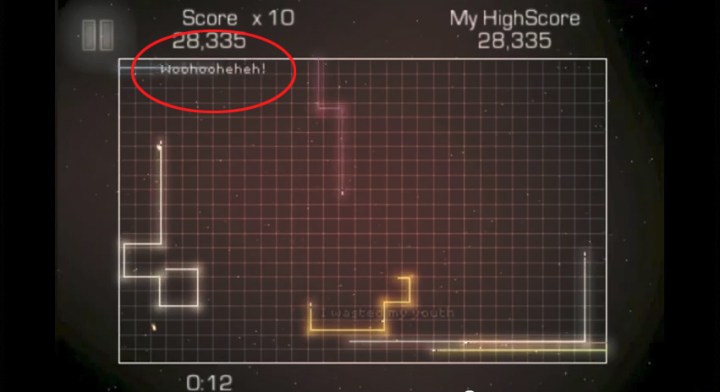
Right. So me and @rob_innit do this thing in the office that we call the ‘Woohooheheh’. I can’t really describe it. Though it does have an official smiley.
° ;P /°
The legend that is @spiltmilkstudio loves the Woohooheheh so much that he’s put it in his upcoming iOS game Hard Lines. This is genuinely one of my greatest ever achievements. It also means I can add ‘game developer’ to my CV, right?
Written by Terry’s good friend Barbara Switzer and published on The Morning Star Online. Obituaries are also expected to appear in The Independent and The Telegraph.
—————
Terry Marsland, a leading figure in the upsurge of trade unionism in the 1970s, died earlier this month in her Merseyside home. She was aged 79.
She was a senior official in the Tobacco Workers Union, Tass and MSF and was at the forefront of the struggle for left policies and women’s rights.
She was a member of the TUC Women’s Committee from 1977 until her retirement in 1993.
Terry was born into a large family of Irish Liverpudlians, one of 10 children. She married into a Communist family and was much influenced by her mother-in-law Marion Marsland, an early stalwart of the National Assembly of Women, of which Terry became president in 1992.
Terry worked as an official for the Goldsmiths and the Bank Employees unions before becoming a national official of the Tobacco Workers’ Union in 1973 and later the deputy general secretary.
A forceful and compelling public speaker, she addressed CND rallies and spoke at Greenham Common, The Women’s Peace camp, taking her daughters with her.
She moved the first pro-abortion resolution at the TUC in 1975 and with her union’s full support became a leading activist for peace and international solidarity.
When the Tobacco Workers Union merged with Tass in 1986 she took over the leading role in the women’s structure and took forward an effective and democratic force in the new union MSF in 1988.
Terry’s commitment to fighting for women’s rightful place in the trade union movement went far beyond her own union.
She convened regular meetings of left women activists from many others in order to fight for progressive policies at the TUC.
This group of left women took a lead in organising support for progressive women to be elected to the general council.
When Fire Brigades Union general secretary Ken Cameron began a root-and-branch examination of the union’s equality policy he sought advice from Terry.
She spoke at the first FBU women-only weekend at Wortley Hall.
She was inspirational.
She showed what women, united, could achieve in their trade union, their workplace and in their personal lives and relationships.
Besides her many trade union commitments, Terry was always a champion of the Morning Star. She was a Communist Party member for most of her adult life and as such made important contributions to the work of the party, particularly in helping to develop policies and cadres among women activists in the trade union movement.
Mick Costello, the party’s national industrial organiser in the late 1970s and early ‘80s, paid tribute to her contribution.
“Terry Marsland was in the tradition of Communists who never lost sight of the importance of winning socialist advance if the gains won in the daily struggles of the working class, its unions and the democratic movement were to be secured.”
Terry served on the Equal Opportunities Commission, the Acas council, the Employment Appeal Tribunal and the Women’s National Commission. After her retirement she became involved in local politics.
She was the independent chairwoman of the Warrington Borough Council standards committee, a member of the Cheshire Fire Authority and a non-executive director of the Cheshire and Merseyside Strategic Health Authority.
Communist Party trade union co-ordinator Anita Halpin, who formerly chaired the TUC Women’s Committee, said of Terry: “She will be remembered as one of all too few senior women trade unionists.
"As a full-timer she remained a working-class champion, never becoming a bureaucrat. As all true socialists Terry was an internationalist and will remain a role model in the true sense of the words for all sisters.”
Her last public speaking engagement was in March, fittingly at the Merseyside Women’s Movement celebration of the Centenary of International Women’s Day.

You don’t really tire of images like this
Official animated movie of Tim Minchin’s 9-minute beat poem Storm. Written and performed by Tim Minchin. Great ammo for when you need to get your pro-science guns out.

Sounds like I’m the last person in the world to see this. But my, what a photo.
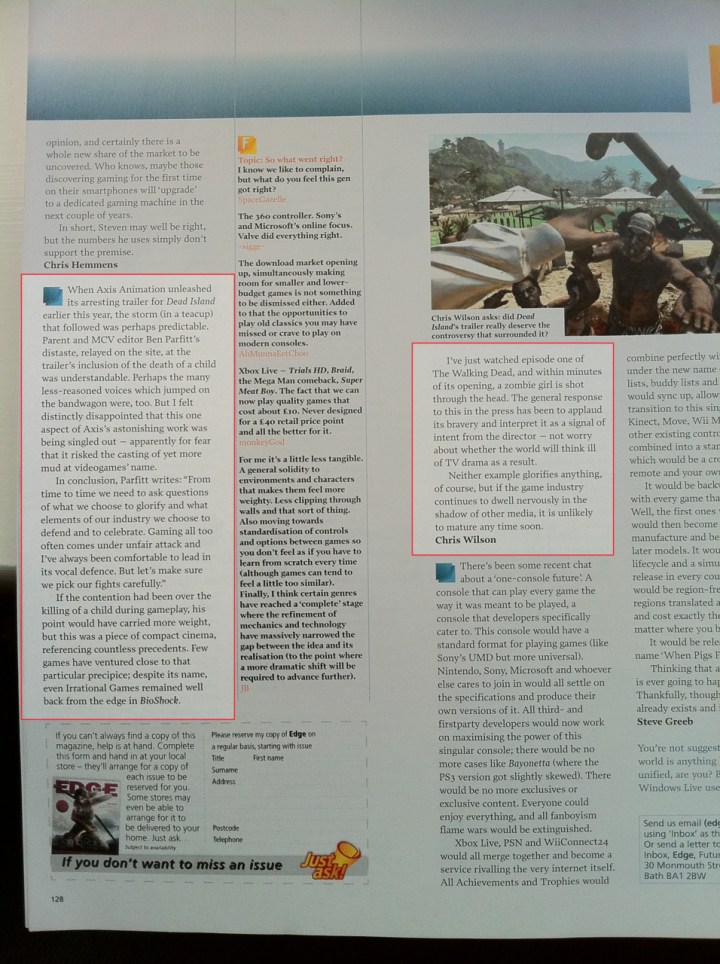
I was tipped off by last night about a letter in the most recent issue of Edge (228) concerning an Opinion piece I published in February discussing the Dead Island trailer released that month. Here it is.

 ben parfitt